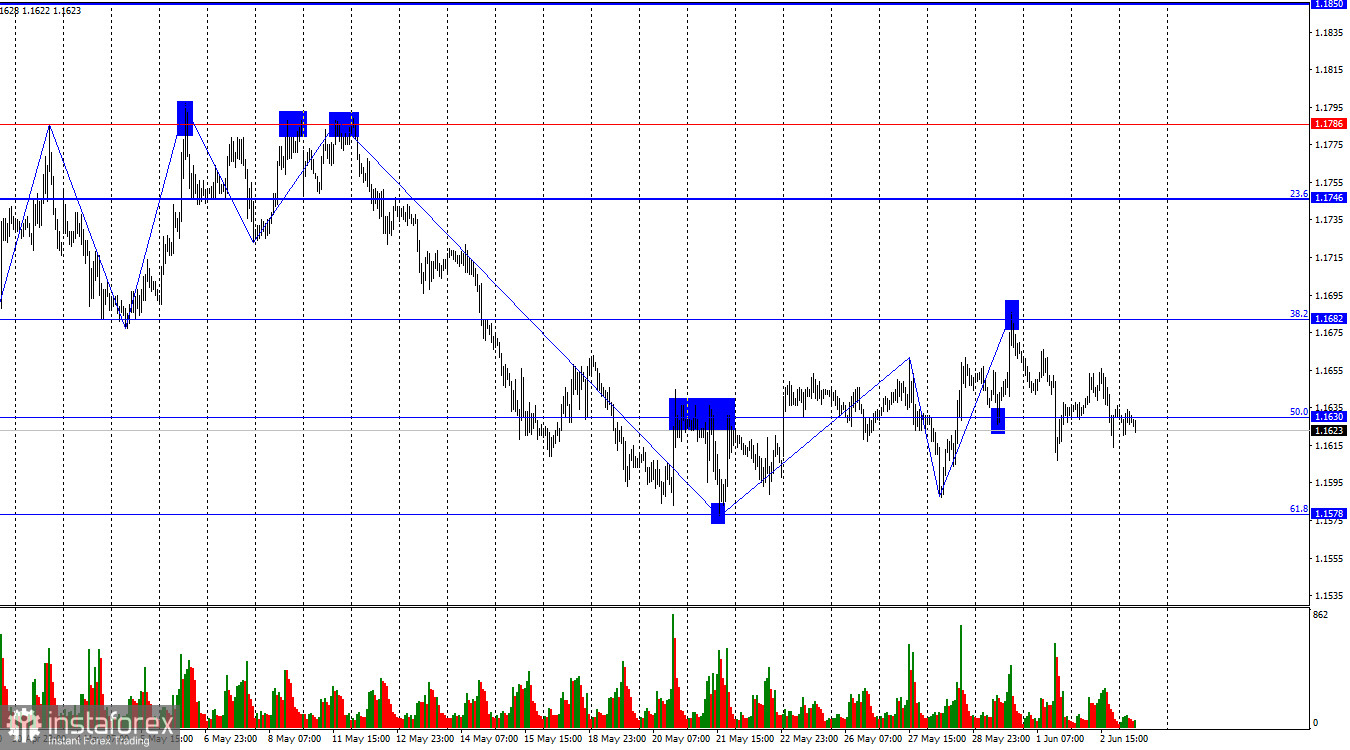
On Tuesday, the EUR/USD pair declined below the 50.0% Fibonacci retracement level at 1.1630. However, neither bulls nor bears currently possess enough strength to launch new attacks. As a result, the downward movement may continue today toward the 61.8% retracement level at 1.1578. At the same time, a renewed consolidation above the 1.1630 level remains highly likely and would allow traders to expect growth toward the 38.2% Fibonacci level at 1.1682.
The wave structure on the hourly chart remains straightforward. The latest completed upward wave broke above the previous peak, while the latest downward wave failed to break below the previous low. Therefore, the trend has shifted to bullish. Bulls will only be able to continue their advance if Iran and the United States sign an interim agreement, stop violating the ceasefire terms, and the Strait of Hormuz is reopened in the near future. Without these developments, it will be extremely difficult for them to launch a sustained offensive.
Several notable reports were released in both the European Union and the United States on Tuesday. Unfortunately, they once again failed to attract traders' attention, although they allow for several important conclusions. An acceleration in inflation in the Eurozone to 3.2% year-on-year and in core inflation to 2.5% year-on-year gives traders reason to expect tighter monetary policy from the European Central Bank. It hardly needs to be said that higher interest rates are generally a bullish factor for a currency, especially if other central banks are not expected to tighten policy. The Federal Reserve and the Bank of England are highly unlikely to adopt hawkish decisions in June. Therefore, the euro could have been expected to rise yesterday and today, but instead it remains under pressure. Could the JOLTS report have prevented the bulls from launching an attack? The report showed a reading significantly above market expectations, but in my view, the JOLTS data had little to do with the pair's decline. The same can be said about geopolitics, which has been changing direction several times a day in recent weeks. In my opinion, bulls and bears are engaged in a tug-of-war within a limited price range, paying little attention to incoming news and economic data. Trading activity remains extremely low.
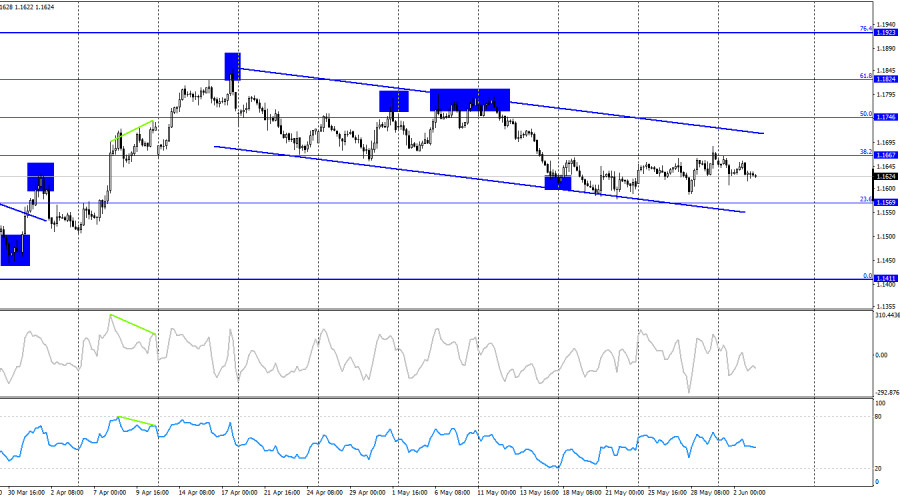
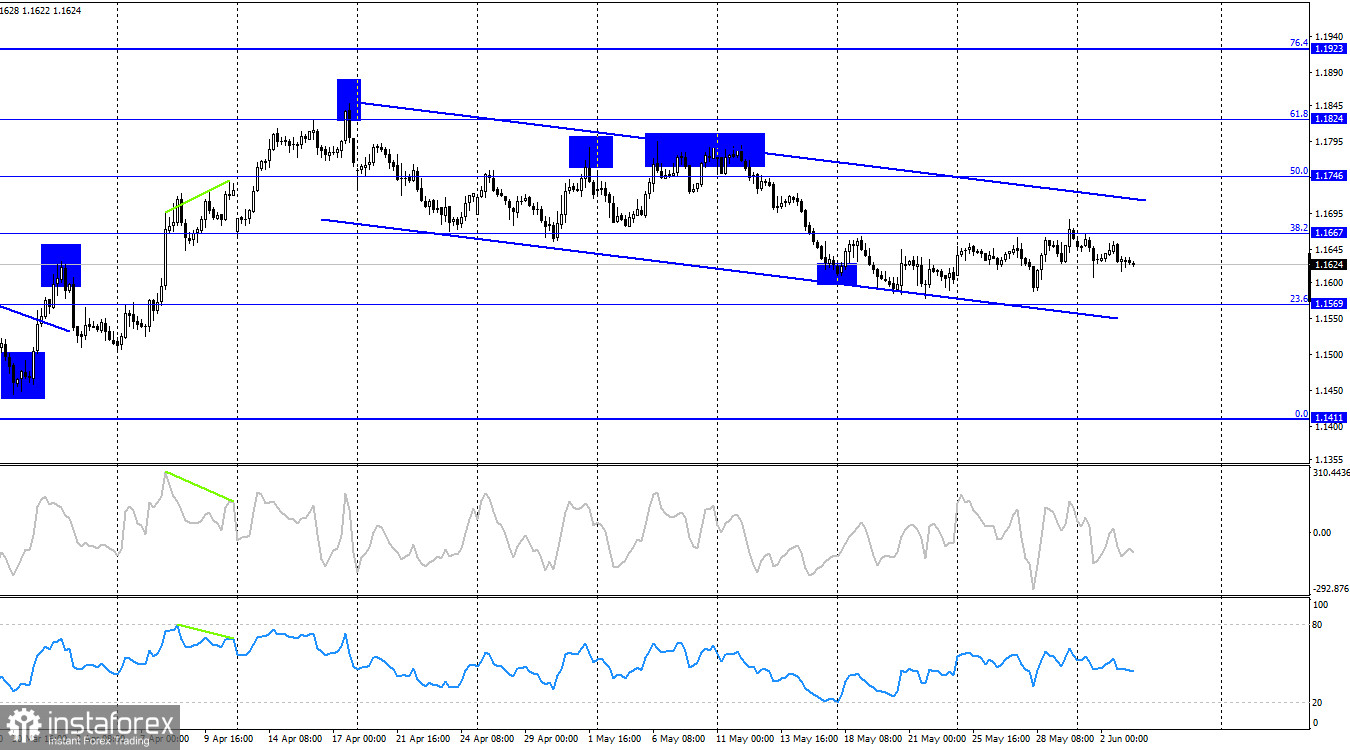
On the 4-hour chart, the pair continues to trade within a horizontal range between the 23.6% retracement level at 1.1569 and the 38.2% retracement level at 1.1667. The market is in no hurry to open new positions or draw firm conclusions. At the moment, I recommend focusing primarily on the hourly chart, as price movements have remained relatively weak in recent weeks. No emerging divergences are currently observed on any indicator.
Commitments of Traders (COT) Report:
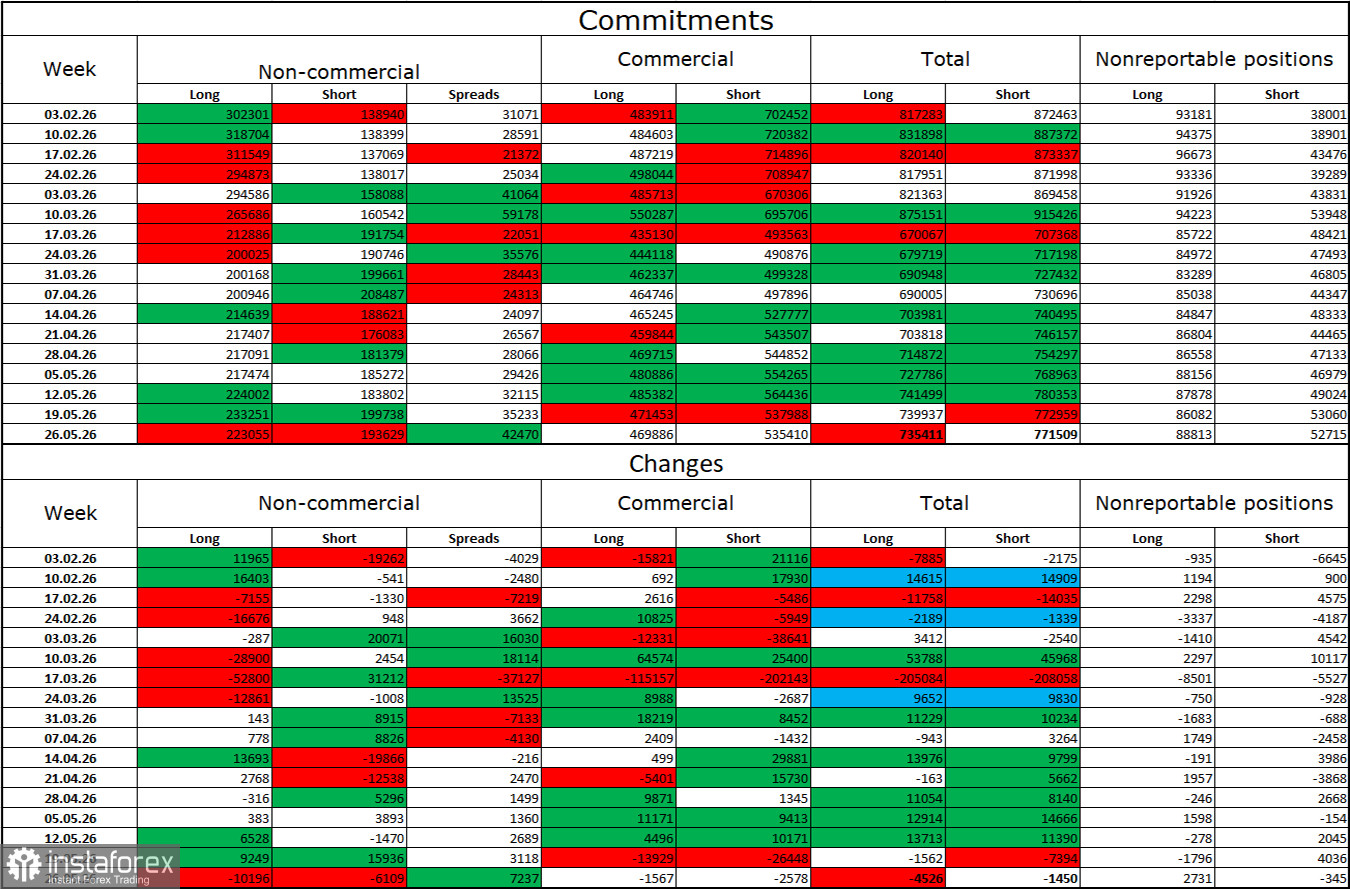
During the latest reporting week, professional traders closed 10,196 Long positions and 6,109 Short positions. Over the seven weeks of February and March, the bulls' overwhelming advantage disappeared due to the war in Iran, while over the past nine weeks the situation has become more balanced amid the suspension of military activity in the Middle East. The total number of Long positions held by speculators currently stands at 223,000, compared with 193,000 Short positions. The gap is once again widening in favor of the euro.
Overall, large market participants continue to view the euro favorably over the long term. Naturally, various global developments—which have been abundant in recent years—continue to influence investor sentiment. In particular, the market's attention remains focused on the Middle East, where the war has merely been paused rather than concluded. Consequently, in the near term, the euro and the U.S. dollar will be driven not by Federal Reserve or ECB monetary policy, nor by economic data, but by developments in Iran.
Economic Calendar for the United States and the Eurozone:
- Germany – Services PMI (07:55 UTC).
- Eurozone – Services PMI (08:00 UTC).
- United States – ADP Employment Change (12:15 UTC).
- United States – ISM Services PMI (14:00 UTC).
The economic calendar for June 3 contains four events, with the U.S. releases being the most noteworthy. Economic data may influence market sentiment during the second half of Wednesday's trading session.
EUR/USD Forecast and Trading Recommendations:
Short positions were possible following a rebound from the 1.1682 level on the hourly chart, with targets at 1.1630 and 1.1578. The first target has already been reached. New short positions may be considered following another rebound from the 1.1682 level. Long positions may be opened following a rebound from the 1.1578 level, with targets at 1.1630 and 1.1682.
Fibonacci retracement levels are plotted from 1.1409 to 1.1850 on the hourly chart and from 1.2081 to 1.1411 on the 4-hour chart.